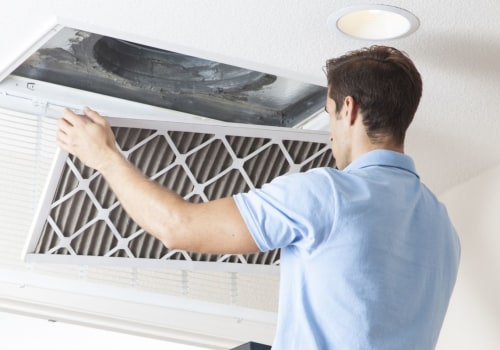
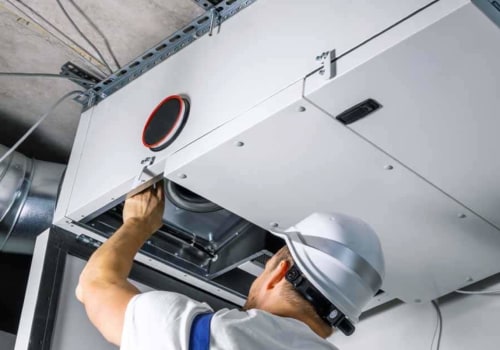
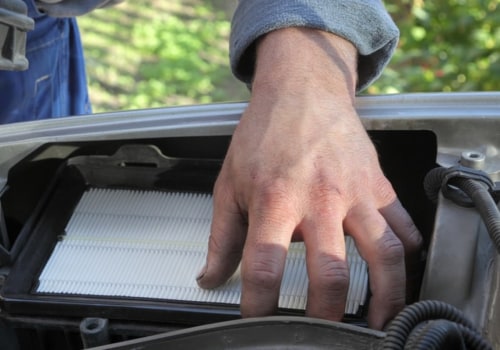
We run pressure tests on St. Cloud homes every week, and the number comes up the same way it always does: somewhere between 20 and 30 percent of the conditioned air the homeowner paid for never reached a single room. It leaked into the attic. It seeped through wall cavities. It disappeared into a crawl space. The U.S. Department of Energy has documented this loss rate across American homes for years — but we see it on a gauge, on a screen, in a number we hand to the homeowner before we leave the driveway. That's not abstract. That's your electric bill.
Osceola County's climate makes this problem sharper than most. Air conditioning runs nearly year-round here. Humidity accelerates duct wear in ways it simply doesn't in cooler, drier climates. And the longer a leak goes unaddressed, the wider it gets. If you're in St. Cloud and your energy bills have climbed without explanation — or if certain rooms just won't stay comfortable no matter what you set the thermostat to — duct integrity is almost certainly part of the answer. This guide covers the full picture: what duct sealing is, why St. Cloud homes need it more than most, how to recognize the warning signs, what the sealing process looks like step by step, and exactly how Filterbuy HVAC Solutions delivers documented results on every appointment.
TL;DR — Quick Answers
Air duct sealing closes gaps and leaks in HVAC ductwork so conditioned air reaches the rooms it was built to reach — not your attic or crawl space.
St. Cloud homes need it more than most: Florida's year-round cooling demand and humidity wear ducts down faster than cooler climates, making leaks both common and costly here.
The DOE confirms 20–30% of conditioned air escapes through duct leaks in the average home — that's 20–30 cents of every cooling dollar producing no comfort.
Aeroseal is an injectable polymer sealant that bonds to leak edges from inside the duct network, reaching walls and ceilings where manual sealing can't go, backed by a 10-year warranty.
Sealing closes the unfiltered-air bypass that pulls attic dust and allergens into your supply — your MERV-rated filters then perform at full rated efficiency for the first time.
Most St. Cloud homeowners save $180–$320 per year after sealing, with HVAC energy use reductions of 20–40% depending on how badly the ductwork had deteriorated.
MERV 11 or MERV 13 pleated filters suit most St. Cloud homes post-sealing; choose MERV 13 for allergy sufferers, asthma, or pets.
Filterbuy HVAC Solutions handles duct sealing in St. Cloud with EPA-certified technicians, guaranteed upfront pricing, and printed before-and-after pressure test documentation on every appointment.
Top Takeaways
Duct leaks drain 20–30% of conditioned air before it reaches a single room — a measurable monthly cost in St. Cloud's demanding year-round cooling climate.
Seven signs flag duct leakage without any test: uneven temps, climbing bills, fast-returning vent dust, musty register odors, indoor allergies worse than outside, a system that never cycles off, and visible duct gaps.
Aeroseal seals from inside the duct network, closing leaks in walls and ceilings manual sealing can't access, with a 10-year manufacturer warranty on qualifying installs.
Sealed ducts activate your MERV-rated filtration — a MERV 11 or MERV 13 pleated filter in a sealed system outperforms a higher-rated filter in a leaking one.
Annual energy savings of $180–$320 are typical for a standard St. Cloud home, with full payback in two to three cooling seasons and faster returns on older ductwork.
Filterbuy HVAC Solutions delivers guaranteed pricing, EPA-certified technicians, and documented pressure test results on every St. Cloud and Osceola County appointment.
Duct sealing scales equally to residential and commercial HVAC — energy savings and air quality improvements grow with the size of the building.
What Air Duct Sealing Is — and Why This Climate Makes It Critical
Air duct sealing closes the gaps, cracks, and separated joints in your HVAC ductwork so conditioned air reaches the rooms it was meant to reach — not the attic, not the wall cavity, not the crawl space underneath the house. Every cubic foot that escapes is air you paid to cool or heat. It delivers no comfort. It does nothing for indoor air quality. It's a cost with no return.
St. Cloud sits in one of the most demanding HVAC climates in the country. Osceola County heat and humidity drive your air conditioning system hard — often 10 or more hours a day in summer. That sustained pressure expands duct joints, degrades sealants, and pushes existing gaps wider with every season. Ductwork that holds up for 25 years in a northern climate can show real deterioration here in 10 to 15. We see it on nearly every service call we run in older St. Cloud neighborhoods.
Duct integrity also determines how well your air filters actually perform. When ducts leak, unfiltered air bypasses the filter entirely — pulling insulation particles, mold spores, and attic dust into your air supply before any of it crosses the filter media. Sealing the ductwork is what makes a MERV-rated filter perform at its rated efficiency. Without sealed ducts, even a MERV 13 is only doing part of its job.
7 Warning Signs Your St. Cloud Home Needs Duct Sealing
None of these require a professional test to notice. If your home shows two or more, duct leakage is almost certainly a factor.
1. Rooms That Won't Cool or Heat Evenly
One bedroom is comfortable. Another stays warm regardless of thermostat settings or how long the system runs. Leaking ductwork redirects conditioned air before it reaches the registers serving those rooms. The setpoint never gets met because the air meant for that space escapes before it arrives. We've traced more thermostat complaints to duct leakage than to any other single cause.
2. Energy Bills That Climb Without a Usage Change
Your system compensates for lost airflow by running longer. Longer runtime means higher consumption — and a bill that grows even when your household habits haven't changed. Customers who call us about high energy bills in St. Cloud frequently discover their ductwork is the cause, not the equipment itself.
3. Dust Accumulating on Vents Within Days of Cleaning
Leaky return ducts pull air from attics and wall cavities packed with construction debris, insulation fibers, and settled dust. If you're wiping down vents every week, your duct system is delivering contaminated air into the house — not filtered, conditioned air from your HVAC system.
4. Musty or Stale Odors Coming from Registers
St. Cloud's humidity feeds mold and mildew growth in every unconditioned space in a home — attics, crawl spaces, wall interiors. When duct leaks connect those spaces to your supply or return network, those odors travel directly into your living areas. The smell doesn't go away with an air freshener. It goes away when the leaks do.
5. Allergy Symptoms Worse Inside Than Outside
Leaking ducts pull outdoor pollen, pet dander, mold spores, and fine particulates directly into your air supply — bypassing your filter before any of it reaches the filter media. If someone in your household has allergy symptoms that get worse at home, their HVAC system may be delivering unfiltered outdoor air straight into their breathing space. Air purification and quality filters can't protect against contaminants they never see.
6. An HVAC System That Never Cycles Off
A system that runs continuously is one working to reach a setpoint it can't maintain because conditioned air keeps escaping. That overtime operation accelerates wear on the compressor, blower motor, and heat exchanger — shortening equipment life and raising the odds of an expensive repair call. HVAC performance degrades fastest in systems compensating for duct leakage.
7. Visible Gaps or Damage at Duct Joints
Any accessible ductwork — in your attic, garage, or utility space — is worth a look. Separated joints, register boots that aren't flush, or torn flex duct are confirmed leaks. Each one is conditioned air your system produced and lost before it reached a room.
Manual Sealing vs. Aeroseal: How the Work Gets Done
Filterbuy HVAC Solutions uses two field-proven methods. Our technicians assess your duct configuration, accessibility, and leakage severity before recommending an approach — and often apply both in the same home.
Manual Sealing with Mastic and UL 181 Foil Tape
For accessible ductwork in attics, garages, or utility rooms, we apply water-based mastic sealant and UL 181-rated metal foil tape to close gaps, reconnect joints, and seal around register boots. Mastic stays flexible after it cures — that matters in Florida's temperature-cycling environment, where rigid sealants crack and fail over time. One thing our technicians never use: cloth duct tape. It holds for a season and fails before the next one. We've pulled it off joints where a homeowner was told it was an acceptable repair. It isn't.
Aeroseal: Sealing From the Inside Out
For ductwork hidden in walls, ceilings, or floors — where manual access means demolition — Aeroseal closes leaks that weren't fixable a decade ago. The system pressurizes your duct network from a single access point, then injects a polymer sealant mist into the airstream. The particles travel to every leak in the system and bond precisely at the edges of each gap, sealing from the inside out. We call it a glue with a brain: it accumulates only where air is escaping — never on duct walls where it isn't needed.
In the St. Cloud homes we service, Aeroseal consistently delivers 20–40% improvement in duct efficiency. We verify every result with before-and-after pressure testing and document the numbers in a report we give to the homeowner before we leave. The Aeroseal warranty backs those results for 10 years.
Learn more: Aeroseal HVAC Air Duct Sealing in Saint Cloud, FL
How Sealed Ducts Improve Indoor Air Quality in Your St. Cloud Home
Duct leakage isn't just an energy problem. It runs a contamination cycle inside the home. Negative pressure in a leaking duct system actively pulls air from the spaces surrounding the ductwork. In a typical St. Cloud home, that means attic air — loaded with insulation particles, mold spores, and accumulated dust — enters your air supply before a single cubic foot of it crosses your filter. No matter how often you change that filter or how high the MERV rating, it can't clean air that never passes through it.
Sealing the ducts closes that bypass completely. After the appointment, 100% of circulating air passes through your filtration system — and that's when MERV ratings, HEPA upgrades, and replacement schedules start doing the work they were designed to do.
MERV stands for Minimum Efficiency Reporting Value. MERV 8 through MERV 13 pleated filters are the standard for residential HVAC systems in Florida — they capture dust, pollen, pet dander, and mold spores while maintaining the airflow your system needs. HEPA-grade filters (MERV 17+) deliver hospital-level particulate capture for households dealing with severe allergy or asthma conditions. In a sealed system, any of these filters performs at full rated capacity. In a leaking one, none of them do.
The Filterbuy filter line — including MERV 8, MERV 11, and MERV 13 pleated filters — is built to pair with sealed duct systems. Sealed ducts and the right filter and replacement schedule together form the most complete indoor air quality solution available to Central Florida homeowners.
What Duct Sealing Saves: The Energy Numbers for St. Cloud Homeowners
When conditioned air stops escaping, the HVAC system stops running overtime to compensate. For homes with significant duct deterioration, the post-sealing reduction in HVAC energy consumption commonly reaches 40%. For a typical 1,500 sq ft St. Cloud home spending $200–$280 per month on cooling during peak season, sealed ductwork typically delivers $180–$320 in annual savings.
Before duct sealing, homeowners typically spend $220–$280 per month on energy bills, with HVAC systems constantly cycling to compensate for the 20–30% of air lost through leaky ducts — often resulting in uneven temperatures and uncomfortable hot or cold spots throughout the home. After sealing, those losses drop to near-zero, monthly bills fall to around $150–$190 (a savings of $70–$90 per month), HVAC run time decreases by 25–40% to reduce wear and extend equipment life, and conditioned air actually reaches every room, resulting in consistent, even temperatures throughout the house.
Every Filterbuy HVAC Solutions duct sealing project comes with guaranteed upfront pricing and 0% financing for qualifying homeowners. Our price-match guarantee covers both residential and commercial HVAC clients across the St. Cloud area.
The Filterbuy HVAC Solutions Process — Step by Step
We think every homeowner should know exactly what happens during a service appointment before they book it. Here's the full process.
Step 1 — Free Inspection and Baseline Assessment
Our EPA-certified technicians evaluate your ductwork layout, identify accessible versus concealed sections, and document initial airflow conditions. You get a guaranteed upfront price before any work is scheduled. No hidden fees. No surprises on the invoice.
Step 2 — Duct Pressure Test: Measure the Leakage Baseline
We measure exactly how much conditioned air your duct system is currently losing, using calibrated pressure testing equipment. This number becomes the 'before' figure in your results report. You see your home's actual leakage rate in quantified terms — not a general estimate.
Step 3 — Register Sealing and System Pressurization
All supply and return registers are temporarily sealed to isolate the duct network. The system pressurizes to the level Aeroseal's sealant particles require to travel to and bond at every leak point throughout the system.
Step 4 — Aeroseal Injection or Manual Sealing
We apply Aeroseal polymer sealant through the pressurized system, use mastic and UL 181 foil tape on accessible sections, or both — depending on your home's configuration. Most St. Cloud homes benefit from the combined approach: Aeroseal handles the concealed ductwork, manual sealing addresses accessible joints. HVAC performance improvements begin the moment the sealant cures.
Step 5 — Post-Seal Pressure Test and Results Report
We run the same pressure test we ran at the start. Before-and-after numbers are documented in writing and given to you before we leave. Every time. The report shows your leakage reduction percentage and the estimated annual energy savings based on your home's actual measured improvement.
Step 6 — Filter Upgrade Recommendation
With sealed ducts, your air filters receive 100% of system airflow for the first time — possibly in years. Our technicians review your current filter setup and recommend the right MERV rating, size, and replacement schedule for your specific system. Clean air starts with sealed ducts and the right filter working together.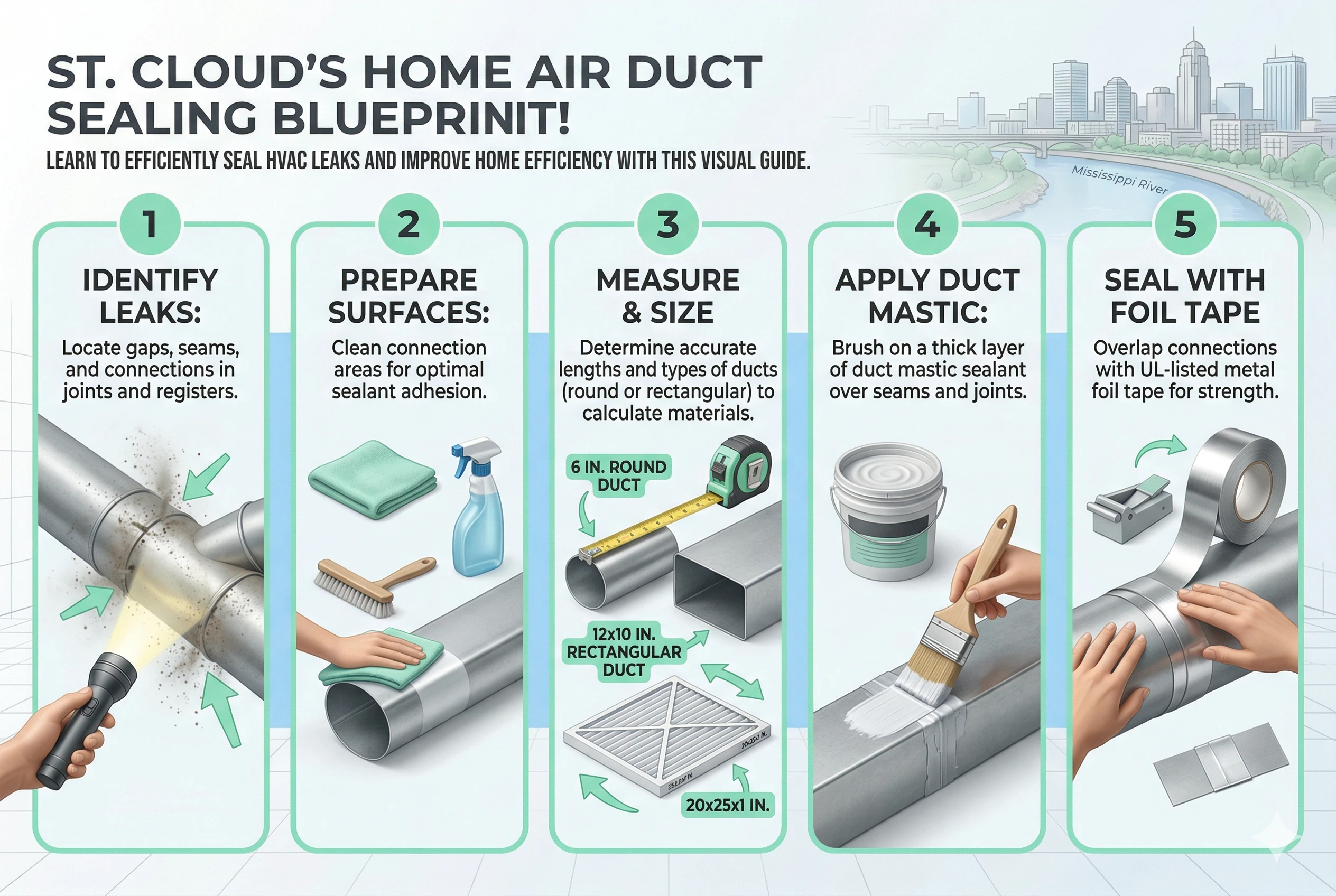
Essential Resources
We tell every homeowner the same thing: do your homework before you hire anyone — including us. The families who make the best decisions about duct sealing are the ones who arrive informed. These seven resources are the same ones our technicians reference, and they'll give you the data, standards, and technical context to evaluate your options with confidence.
1. Confirm the Loss Rate — DOE Duct Sealing Guide
The U.S. Department of Energy quantifies exactly what leaky ductwork costs American homeowners and explains how to identify and address the problem. It's the federal baseline every duct sealing conversation should start from.
Source: U.S. Department of Energy — energy.gov/energysaver/ducts
2. Understand the Health Connection — EPA Indoor Air Quality Resource Center
The EPA's indoor air quality hub documents the direct relationship between HVAC duct integrity and the pollutants your household breathes — including why unsealed ductwork is an air quality risk, not just an energy efficiency problem. This is the resource we point to when homeowners ask why their allergy symptoms are worse inside than outside.
Source: U.S. Environmental Protection Agency — epa.gov/indoor-air-quality-iaq
3. Verify Your Energy Savings Potential — ENERGY STAR Duct Sealing Program
ENERGY STAR's duct sealing program page provides savings estimates calibrated to regional energy rates and confirms which approaches qualify for efficiency program recognition. Use it to validate the return on investment before you commit to an appointment.
Source: ENERGY STAR — energystar.gov/campaign/seal_insulate/ducts
4. Learn the Technology — Official Aeroseal Documentation
Aeroseal's technical hub covers the pressurize-and-inject process, sealant polymer composition, installation certification standards, and the 10-year warranty structure behind the technology we use on every qualifying St. Cloud job.
Source: Aeroseal — aeroseal.com
5. Know the Performance Standards — ASHRAE
The American Society of Heating, Refrigerating and Air-Conditioning Engineers publishes the ventilation and indoor air quality standards that govern HVAC design in the U.S. When our technicians reference performance benchmarks, ASHRAE standards are the basis.
Source: ASHRAE — ashrae.org/technical-resources/standards-and-guidelines
6. Decode MERV Ratings Before Your Filter Conversation — Air Filter Classification Reference
The Wikipedia air filter classification article is the most accessible public reference for understanding MERV ratings, HEPA standards, and how filter efficiency connects to duct integrity. Reading it before your filter upgrade recommendation makes the technician conversation more productive.
Source: Wikipedia — Air Filter Classification and MERV Ratings — en.wikipedia.org/wiki/Air_filter
7. Know What Florida Law Requires of Your Contractor — Florida Building Code
The Florida Building Code's mechanical chapter sets the installation, sealing, and testing requirements for duct systems in the state. Knowing the regulatory baseline helps you confirm that any HVAC contractor you hire — including us — is meeting the standards the state requires.
Source: Florida Building Code — floridabuilding.org/bc/bc_default.aspx
Supporting Statistics
We reference these figures in conversations with homeowners across Osceola County every week — because federal and government-backed data does what no service pitch can: it shows the scale of the problem in plain, verifiable terms.
Stat 1: The Average Home Loses 20–30% of Conditioned Air Through Duct Leaks
The U.S. Department of Energy documents this as a standard finding across American residential duct systems. In St. Cloud's year-round cooling climate, a 20–30% loss rate isn't a background inefficiency — it's a direct monthly cost, a comfort deficit in every room that depends on that air, and an HVAC system running harder than it should every single day. We confirm this exact loss rate with a calibrated pressure test on every appointment. Homeowners see their specific number before we seal anything — and again after, when it's near zero.
Source: U.S. Department of Energy — energy.gov/energysaver/ducts
Stat 2: Americans Spend 90% of Their Time Indoors, Where Pollutant Levels Run 2–5x Higher Than Outside
The EPA's indoor air quality data reframes the duct sealing decision as a health question, not just an energy question. Leaking ducts in a St. Cloud home pull attic and wall-cavity air — loaded with mold spores, insulation fibers, and particulates — directly into the air supply before it reaches a filter. The 2–5x indoor pollutant concentration the EPA documents doesn't happen because outdoor air is clean. It happens because the indoor air system is poorly managed. Sealed ductwork is one of the most direct ways to change that for your family.
Source: U.S. Environmental Protection Agency — epa.gov/indoor-air-quality-iaq
Stat 3: Properly Sealed Duct Systems Reduce HVAC Energy Consumption by 20–40%
ENERGY STAR identifies duct sealing and insulation as one of the highest-return energy efficiency upgrades available to homeowners — with a 20% minimum reduction in heating and cooling consumption for properly sealed systems, reaching 40% for homes with severe duct deterioration. For a standard St. Cloud home spending $200–$280 monthly on peak-season cooling, that range delivers $180–$320 in annual savings. For homes with older ductwork, the return runs higher.
Source: ENERGY STAR — energystar.gov/campaign/seal_insulate/ducts
Final Thoughts: Duct Sealing Is the Highest-Return HVAC Investment in St. Cloud
Most home improvement projects change how a home looks. Duct sealing changes how it works. Lower bills. Quieter operation. Fewer repair calls. Rooms that hold the temperature they're supposed to hold. Air that's been filtered the way the filter was designed to filter it — not contaminated by attic dust before it reaches the register.
In our experience servicing residential and commercial HVAC systems across Osceola County, duct sealing closes the gap between what a home's HVAC system should do and what it's actually doing — faster than any other service we offer. The payback period for most St. Cloud homeowners is two to three cooling seasons through energy savings alone. That math doesn't include the extended equipment life, the reduced filter replacement frequency from a cleaner air supply, or the comfort improvement that shows up the same day we complete the appointment.
Aeroseal has removed the last remaining excuse for delaying this repair. Inaccessible ducts — the leaks in walls, ceilings, and floors that once required demolition to address — are now sealed from the inside in a single visit. There's no longer a valid technical barrier. If the seven warning signs in this guide describe your home, the right next step is a pressure test — not another filter change, not another thermostat adjustment, not another season of paying for air that goes nowhere.
Your Next Steps Toward Lower Bills and Cleaner Air
Taking action on duct leakage is simpler than most homeowners expect. Here's the path from where you are now to a sealed, tested, and documented duct system.
Schedule your free duct inspection. Our EPA-certified technicians run a baseline pressure test and hand you the exact leakage number — not an estimate. You'll know your home's specific loss rate before any work is proposed.
Review your pressure test results and sealing recommendation. We explain the findings in plain language and provide a guaranteed upfront price. Every question gets answered before any decision is made.
Complete duct sealing and confirm results with a post-seal pressure test. The before-and-after numbers are documented in writing and given to you before we leave. You'll feel the difference the same day.
Pair your sealed duct system with the right filter. Our technicians recommend the correct MERV rating and replacement schedule for your home's specific airflow requirements
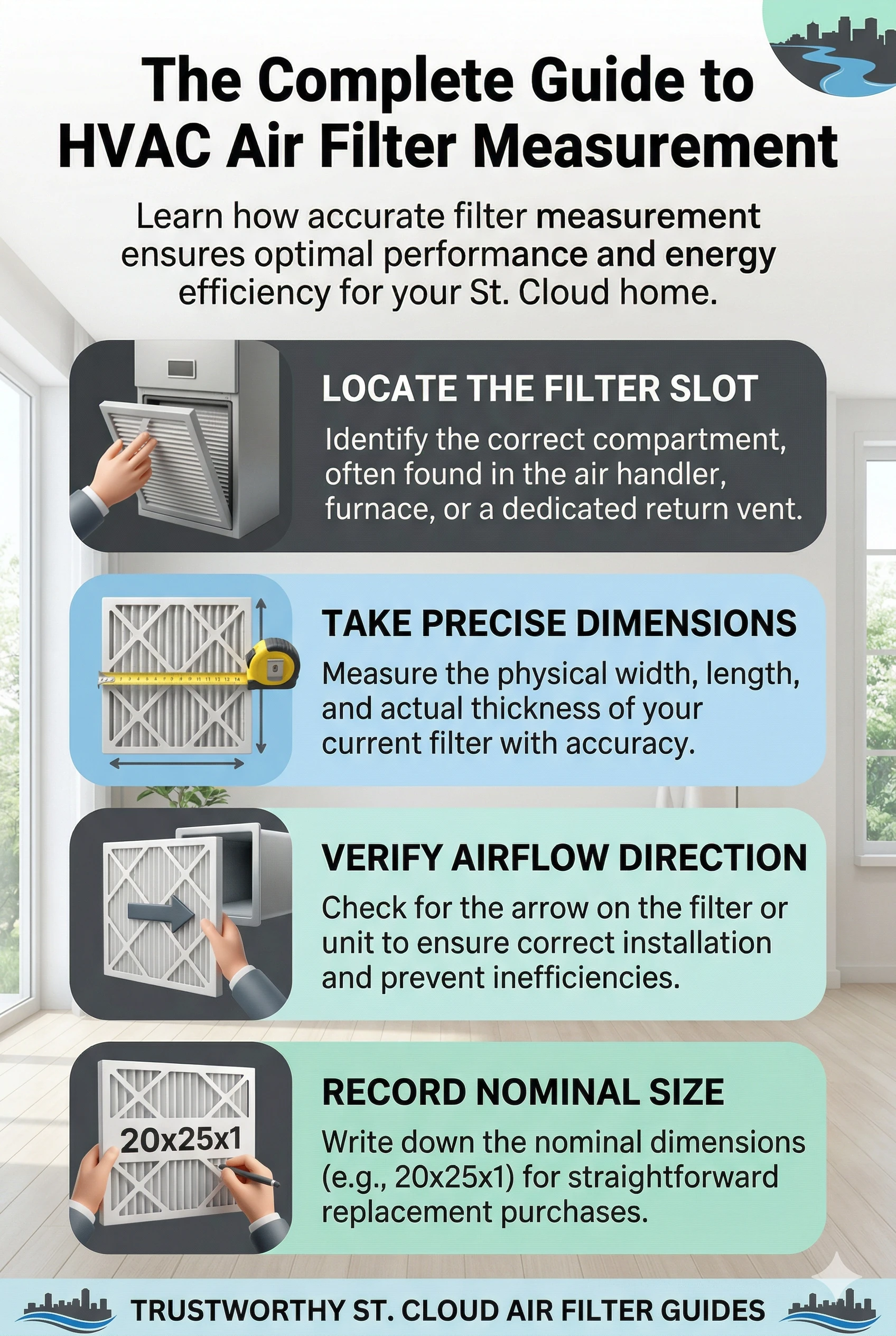 . For most St. Cloud homes, MERV 11 or MERV 13 pleated filters deliver the best balance of filtration efficiency and airflow.
Track your next utility bill. Most St. Cloud homeowners who schedule their sealing appointment this month see measurable reductions before the next billing cycle.
Book Your Free Duct Inspection in St. Cloud | View Aeroseal Duct Sealing Service Details
Frequently Asked Questions About Air Duct Sealing in St. Cloud
Q: How much does air duct sealing cost in St. Cloud?
A: The cost depends on your home's square footage, the configuration and accessibility of your ductwork, and the leakage severity the initial pressure test reveals. Most St. Cloud residential projects deliver full payback through energy savings within two to three cooling seasons. Filterbuy HVAC Solutions provides a guaranteed upfront price before any work begins — no hidden fees, no invoice surprises. Zero-percent financing is available for qualifying homeowners. Call or schedule online for a free inspection and a price specific to your home.
Q: How long does professional duct sealing last?
A: Aeroseal duct sealing carries a 10-year manufacturer warranty. Real-world performance data from Aeroseal installations across North America documents system integrity at 20 years or more under normal operating conditions. Manual sealing with mastic sealant and UL 181 foil tape is equally durable when a certified technician applies it. The variable that determines longevity is installation quality — not the sealant material itself. Cloth duct tape, still sold at hardware stores, fails within a single Florida summer. Our technicians don't use it.
Q: Is duct sealing worth it for an older Florida home?
A: Older St. Cloud homes are typically the strongest candidates for duct sealing. Ductwork installed before the late 1990s was often built with jointing techniques and materials that have degraded significantly under Florida's humidity and temperature cycling. In our experience, homes more than 15 years old frequently show leakage rates well above the 20–30% national average. The energy waste, comfort problems, and indoor air quality issues are proportionally more severe — and the return on investment from duct sealing consistently runs higher in older homes than in newer construction.
Q: What's the difference between duct sealing and duct cleaning?
A: Duct cleaning removes accumulated dust, debris, mold, and biological contaminants from the interior surfaces of your ductwork using vacuum and brush equipment. Duct sealing closes the physical gaps, cracks, and separated joints that let conditioned air escape and outside contaminants enter. The two services address different problems. Duct cleaning improves what's inside your ducts. Duct sealing improves how your ducts function structurally. Many homeowners benefit from completing duct cleaning before duct sealing — cleaning removes debris that could interfere with sealant adhesion and maximizes indoor air quality results.
Q: What MERV rating filter should I use after duct sealing?
A: After sealing, your air filters receive 100% of system airflow for the first time — which makes filter selection significantly more consequential than it was before the appointment. For most St. Cloud residential HVAC systems, a MERV 11 or MERV 13 pleated filter provides the best balance of particle capture efficiency and system airflow. MERV 13 is the right choice for households with allergy sufferers, pets, or asthma — it captures particles down to 0.3 microns, including fine dust, pollen, and some airborne bacteria. HEPA-grade filters (MERV 17+) may be appropriate for specific health conditions but require a system compatibility check. Standard replacement interval in Florida's pollen-heavy climate is 60–90 days.
Q: Does Filterbuy service commercial HVAC systems in St. Cloud?
A: Yes. Filterbuy HVAC Solutions provides both Aeroseal and manual duct sealing for commercial HVAC systems in St. Cloud and throughout Osceola County — including office spaces, retail locations, medical facilities, and light industrial properties. Commercial buildings deal with the same duct leakage issues as residential homes, typically at greater scale and with proportionally higher energy costs. Our commercial HVAC team applies the same before-and-after pressure testing process used in residential work, and all commercial appointments are staffed by EPA-certified technicians credentialed in commercial ventilation system requirements.
Q: How do I know if my ducts are leaking before I call anyone?
A: Several observable symptoms indicate leakage before a professional test: rooms that won't reach setpoint temperatures regardless of thermostat settings; energy bills that climb without a usage change; dust accumulation on vents within days of cleaning; musty or stale odors from registers; and an HVAC system that runs continuously without cycling off. If your home shows two or more of these, duct leakage is almost certainly a factor. Filterbuy HVAC Solutions provides a free calibrated pressure test as the first step of every service consultation in St. Cloud.
Schedule Your St. Cloud Air Duct Sealing Service Today
Sealed ducts mean lower energy bills, cleaner indoor air, and an HVAC system that performs the way it was built to perform. Filterbuy HVAC Solutions has served 200+ communities across Central Florida — and St. Cloud homeowners trust us because we show them the results before we pull out of the driveway.
Why St. Cloud Homeowners Choose Filterbuy HVAC Solutions
Guaranteed upfront pricing — no hidden fees, no invoice surprises, ever
10-year Aeroseal warranty on every qualifying installation
EPA-certified technicians with direct experience in Osceola County's climate demands
Before-and-after pressure test documentation provided on every appointment
0% financing available for qualifying St. Cloud homeowners
Price-match guarantee for both residential and commercial HVAC clients
Most St. Cloud homeowners who schedule their duct inspection this month see measurable results before their next billing cycle. Your HVAC system is built to perform — it just needs sealed ducts to let it.
Book Your Free Duct Inspection → Schedule Now
View Full Aeroseal Service Details → Learn More
Learn more about HVAC Care from one of our HVAC solutions branches…
Filterbuy HVAC Solutions - Miami FL - Air Conditioning Service
1300 S Miami Ave Apt 4806 Miami FL 33130
(305) 306-5027